Skip to content
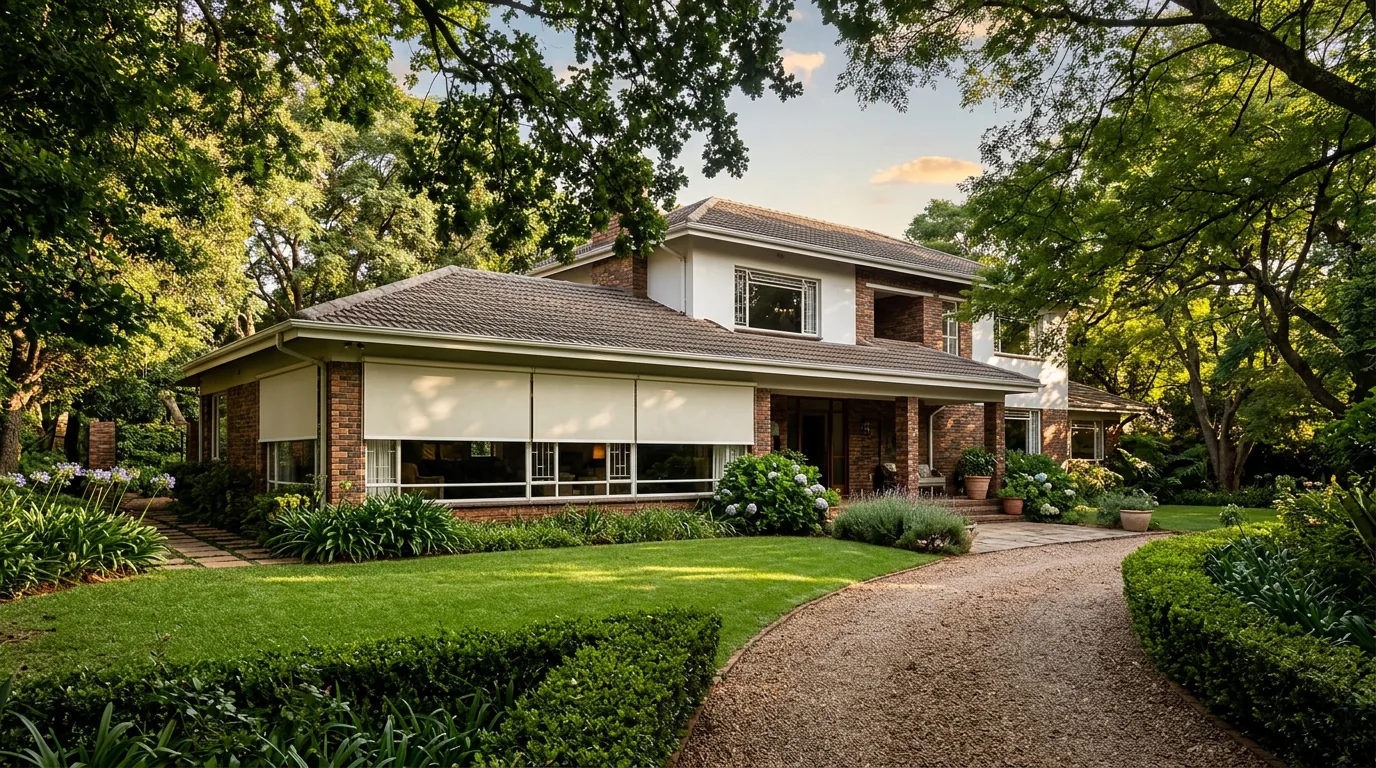
A face-brick family home set well back on a big Hurlingham stand, cream exterior blinds half lowered across the veranda glazing under old trees

Free to read · no sign-up

Acre & Aspect — the Hurlingham Window Survey

How the sun crosses a big Hurlingham stand through the year, what your own garden canopy really does about it, and what we would fit on each elevation — with the honest catch written next to every recommendation. Every figure is sourced at the foot of the page.

  • Written for Hurlingham, with every figure sourced at the foot
  • Free in-home measure & a written per-window quote
  • Cordless and motorised controls, safe for kids and pets

Download this guide (PDF, 1.7 MB) to read later or hand to whoever measures up.

Where to start

Half an acre changes the question.

Hurlingham was proclaimed on 25 May 1938, on a slice of the old farm Zandfontein, and named after an English polo field. What those surveyors laid out has largely survived: stands still run roughly 2,000 to 4,000 square metres — half an acre to a full one — on quiet, boomed-off streets under old trees.

That size changes the brief more than anything else. On a small plot, what sits outside your window is a wall or a pavement; here it is your own garden. The shade you rely on is an asset you can prune, and the problem is rarely privacy — it is glare, heat and fade, crossing open ground.

One thing to file away: Sandton's towers sit about 2.6 km east of here, on a bearing near 101°. That is very nearly where the December sun comes up.

The light here

Twenty-six degrees south, high on the Highveld.

Hurlingham has no weather station of its own, so every figure below is Johannesburg-wide or Highveld-wide — and every one of them is sourced at the foot of this page.

21 Dec — about 87° at noon 21 Jun — about 40° at noon East West rises 116° (Dec) · 64° (Jun) sets 243° (Dec) · 295° (Jun)
  1. Overhead in December, low and due north in June

    At the December solstice the midday sun reaches about 87.2°, within three degrees of straight up: the roof takes the load and a north wall is barely lit at noon. In June it sits at 40.4°, due north, all day — free winter warmth through the pane that cooked you in January.

  2. In midsummer the sun rises and sets behind the house

    Midsummer sunrise is on a bearing of about 116° and sunset about 243°, both south of the east–west line, with 13h 47m of daylight between 05:13 and 19:00. By June they swing to 64° and 295°. So the setting sun sweeps a 52-degree arc across the west of the house, low every time — and the December sunrise comes up within fifteen degrees of the Sandton skyline.

  3. Wet, stormy summers and dry, cold winters

    Hot days, afternoon thundershowers and cool evenings from October; dry sunny days and cold nights through winter. A January mean maximum near 25.6 °C, a June maximum of 17.3 °C with nights around 4.7 °C, occasional frost, and roughly 713 mm of rain, almost all in summer.

  4. Hail season is mid-November to February, in the afternoon

    A fourteen-year satellite catalogue puts South Africa's hail squarely on the Highveld, most frequent mid-November through February and peaking between 13:00 and 17:00 UTC — three to seven in the afternoon, our time — with roughly 180 events on about 58 days a year.

  5. Altitude buys extra ultraviolet, and ultraviolet costs you fabric

    Ultraviolet climbs roughly 10% per 1,000 m of altitude and is highest under exactly the cloudless skies a Highveld winter specialises in; Johannesburg's summer UV index is routinely called extreme. Sunlight breaks the bonds in dyes and weakens fibres — phototendering — fading a rug, an oak floor, and in time the blind.

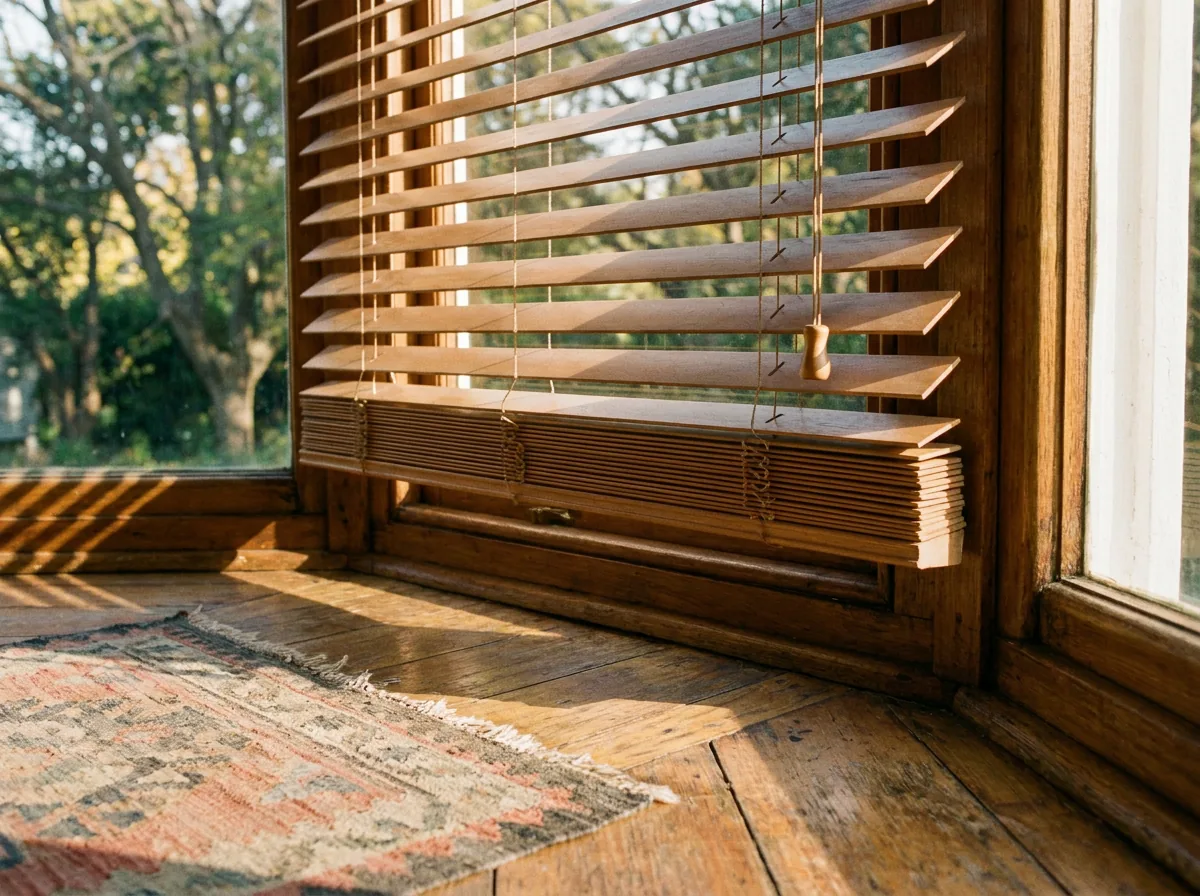
Timber venetian slats raised and stacked at the head of a bay window, late sun falling across old floorboards and a faded rug

Low sun is a sideways problem.

A blind that only travels up and down has one answer to a twenty-degree afternoon sun: cover the window, lose the room. A slat that tilts has a second.

Elevation by elevation

Four walls, four different problems.

Open the compass on your phone and do one lap of the house. On a stand this size, aspect decides the answer more reliably than the room's use.

  1. North — try geometry before you spend

    North glass takes a near-vertical sun in summer and a low one in winter — the one elevation where a horizontal projection works, because a deep veranda blocks most of December while letting all of June in. Many houses here already have one. Stand under it at noon in February: often the answer is a sunscreen for glare and nothing for heat.

  2. West — the elevation that ruins afternoons

    Sunset runs between 243° and 295° across the year, and by then the sun is low: it arrives under the eave, straight at the glass, so an overhead projection does almost nothing. On a big stand what stands in its way is open lawn. If there is one elevation to spend properly on, it is this.

  3. East — the same geometry, half the penalty

    East glass gets the mirror image from 05:13, but the air and the brickwork are still cool, so glare and waking early matter more than heat. East bedrooms are a blockout conversation; an east breakfast room is not — there the sun is the point.

  4. South — not immune, just late to it

    Because midsummer sunrise (116°) and sunset (243°) both sit south of the east–west line, a south wall takes low direct sun early and late in December, then none in winter. The coolest, flattest-lit rooms in the house. Sometimes the honest recommendation for a south window is to spend nothing.

What we would fit, and why

The reasoning — and the honest catch with each.

Each beats its obvious alternative somewhere, and each costs you something — so the catch is written beside it. Tap Add to my window list and it carries down to the form below.

Roller blinds — sunscreen or blockout

Best on: garden-facing living rooms (sunscreen) · bedrooms (blockout)

Why here. A 3–5% openness sunscreen keeps the garden view that is most of the reason people buy here, while cutting glare and much of the ultraviolet that fades floors at this altitude. Blockout does the opposite job — and first light is 05:13 in midsummer.

The catch. Sunscreen reverses after dark — lights on inside, and it gives away more than you expect. Blockout is only as dark as its edges: inside a reveal, a light line runs down each side. A double roller puts both on one window.
Day & night blinds

Best on: rooms facing a driveway, a pool or a boundary hedge

Why here. Alternating sheer and solid bands slide past each other, so one blind moves from open view to eye-level privacy without ever being raised.

The catch. Never a true blockout, and the banding is a strong horizontal pattern against plain joinery. Hold a sample up before committing an elevation to it.

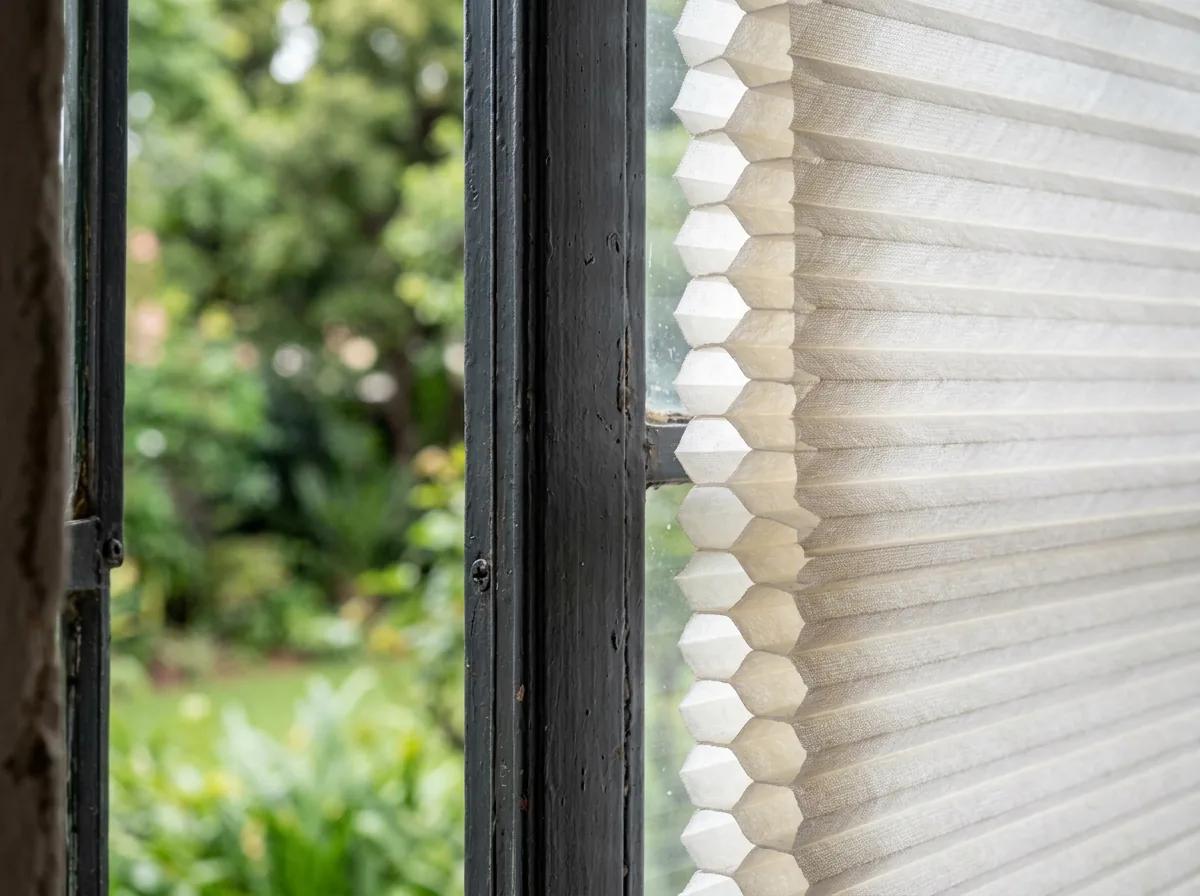
A cellular honeycomb blind seen edge-on inside a black steel casement window, its air cells visible in cross-section with the garden green beyond the glass

Cellular (honeycomb) blinds

Best on: single glazing you cannot or will not replace

Why here. The fabric folds into cells that hold still air against the glass. In a mid-century room with single panes and June nights near 4.7 °C, that trapped air is the least invasive comfort upgrade going: no new frames, no altered openings.

The catch. It sits on the wrong side of the glass for summer heat — it only slows what already came through the pane. Against a hard west sun an external product wins, and there the answer is usually both.

Timber & aluminium venetian blinds

Best on: studies and living rooms (timber) · kitchens and bathrooms (aluminium)

Why here. Low western sun is a sideways problem, and a tilting slat answers it sideways: close the angle and the room stays bright while the beam stops. A roller has one move; a slat has two.

The catch. Timber stacks deeper than a roller, so it eats more glass when raised — noticeable on a short casement. It also dislikes steam, which is why wet rooms get aluminium.

Vertical & panel blinds

Best on: the wide sliding doors onto a terrace or pool

Why here. Vanes and sliding panels cover a four-metre opening edge to edge and stack clear of the glass, so the door still works and the garden still reads.

The catch. Vanes swing about in the draught through an open door, and a panel blind needs wall to stack onto. Where a room runs glass-to-corner there is none, and a wide roller wins.

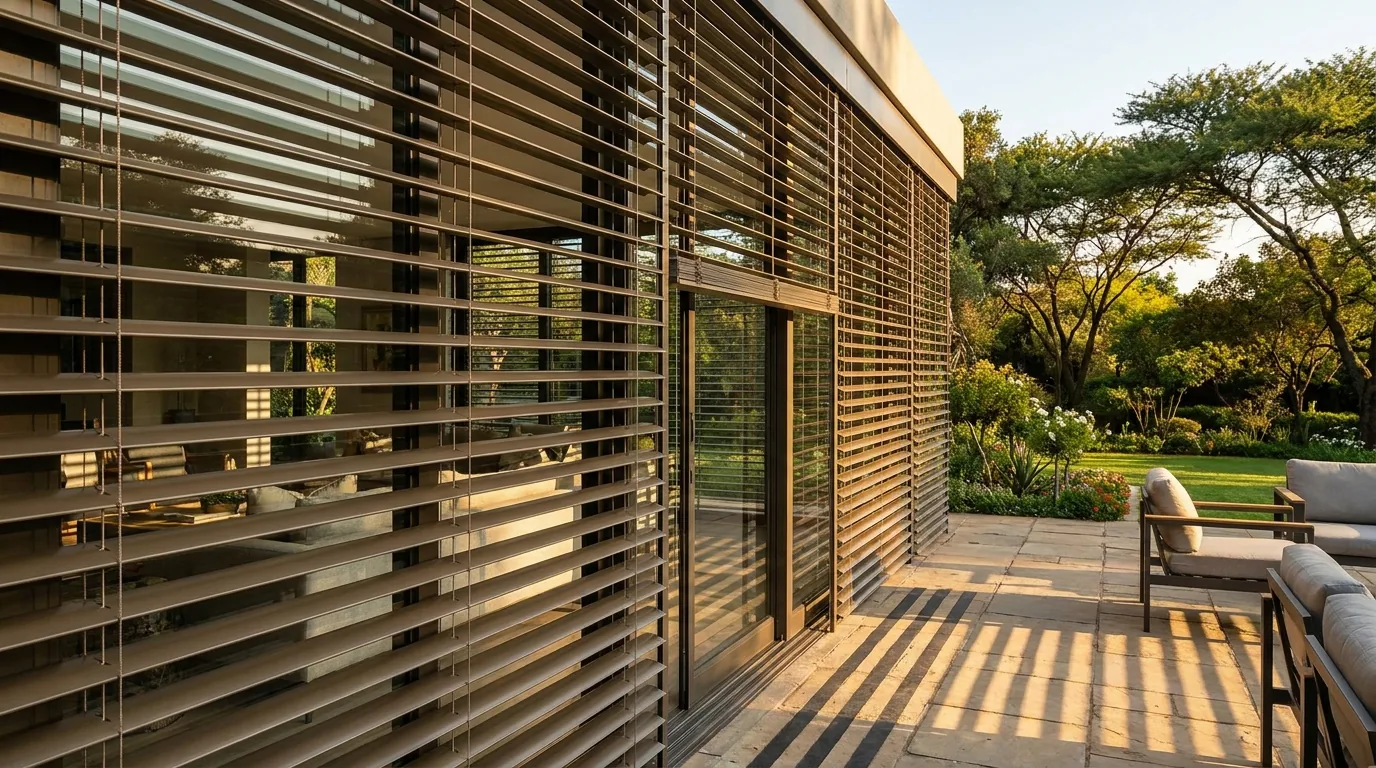
External venetian blinds mounted outside a long run of sliding doors, aluminium louvres tilted against low sun and striping the terrace paving

External venetians & roller shutters

Best on: hard west and north-west glass with no overhang

Why here. Both stop the sun outside the glass, which keeps a room cooler than absorbing it inside. An interior blockout kills glare instantly, but the pane behind it still heats and radiates — which is why a west lounge stays uncomfortable after sunset. External venetians tilt, so a view survives them.

The catch. In relative terms the dearest answers here. Both need a wind strategy through hail season, both usually want a motor, and both are exterior alterations to a house that may be over sixty — read the next section first.

Shading, not security. Fitted outside the glass, these deal with sun, heat, glare and privacy. Security-rated shutters are a different product line, and we will quote on those separately if you want them.

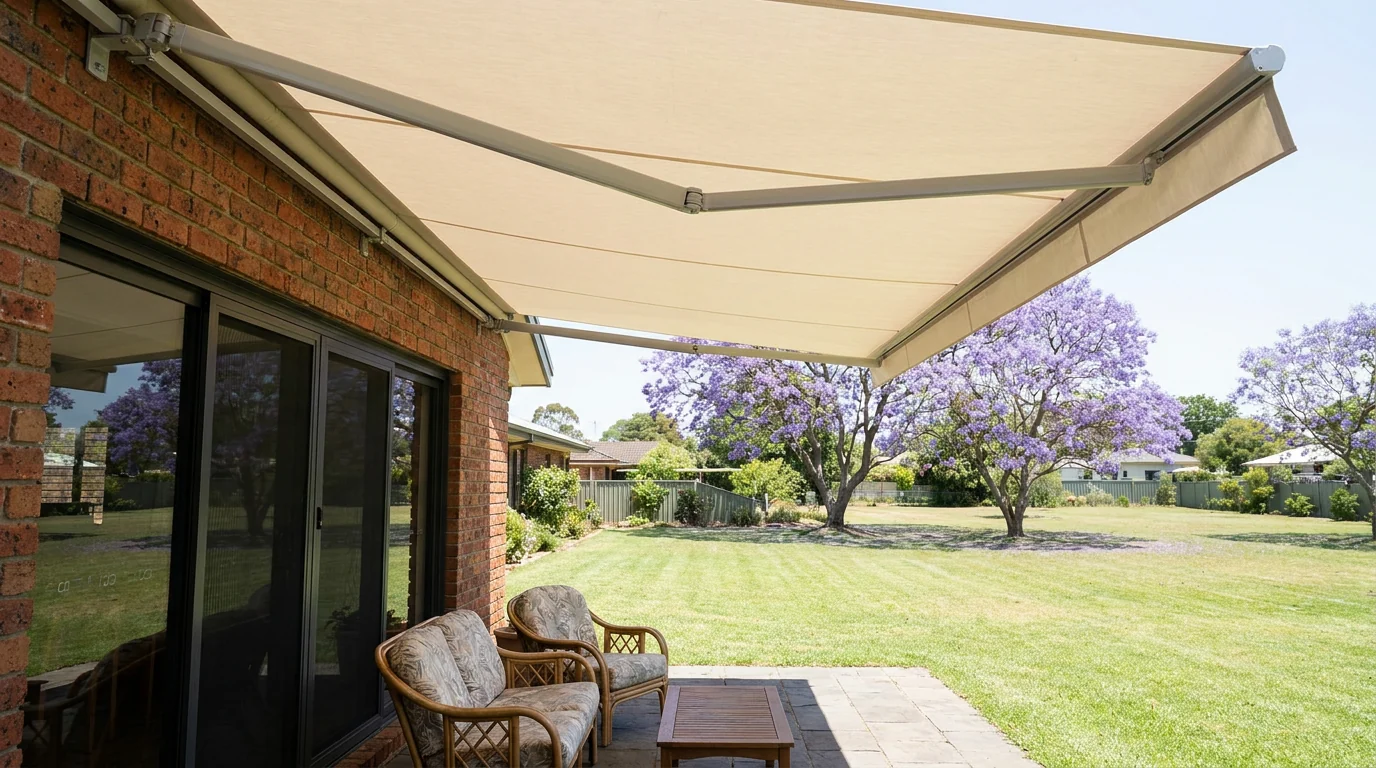
Looking out from under a cream folding-arm awning fixed to the house wall, its front bar framing a sunlit Hurlingham lawn and jacaranda trees

Folding-arm awnings & zip screens

Best on: the terrace, the pool side, the braai

Why here. An awning shades a terrace with nothing in the way of the table, which is why it beats a fixed pergola where you want the June sun back. A zip screen does a different job: fabric under tension in side channels, holding its shape in wind.

The catch. This is the Highveld from mid-November to February, and the storms peak in the exact hours people are outside. Wind ratings are engineering limits, not marketing copy — so we specify a motor and wind sensor rather than a cheaper manual awning.

Motorisation & automation

Best on: wide glass, stair voids, gables, anything outdoors

Why here. A blind nobody can reach is a blind nobody adjusts — and an unadjusted blind is just a permanently dark room. On a wall of four or five, one remote decides whether they get used. Outdoors, a wind sensor retracts the awning before the storm arrives, including while you are on the spruit path.

The catch. Motors need power, and a cable route that does not chase a wall is a real question in a house of this era. Battery motors trade that for a charging routine.

Optional

Want this Survey marked up for your own house?

Tell us which rooms are the problem and we'll send it back with notes against your own elevations — what we would start with, and what we would leave alone. No visit involved, no obligation.

We use these details only to send you the marked-up Survey and, if you ask for it, to arrange a consultation call-back (POPIA). You won't land on a marketing list, and your details are not passed on to anyone else.

Before anything gets mounted outside

Freehold, booms, and the sixty-year question.

Hurlingham is unusual among its neighbours in being almost entirely freehold — roughly five hundred properties, very few sectional title. Good news for anything mounted outside: no body corporate and no trustees' resolution, the hurdle that slows this job in the cluster suburbs a kilometre away. The booms manage who drives in; there is no architectural committee and no published design code.

What does apply is age. Section 34(1) of the National Heritage Resources Act 25 of 1999 says no structure older than sixty years may be altered or demolished without a permit from the provincial heritage authority — and "alter" is defined broadly: any action affecting the structure, appearance or physical properties of a place. Age is the trigger, not listing, and a 1938 suburb has houses well past it.

So: blinds fitted inside touch neither the structure nor how the house reads from the street. Anything mounted outside does. We fit blinds and are not heritage practitioners, so we raise it at the measure and design the interior specification so you have a good option either way.

One more piece of geography. The suburb runs from Republic Road down to the Braamfontein Spruit, so the ground falls toward the watercourse — and on a clear, still night cold air, being denser, drains downhill and pools at the lowest point. At the spruit end, take insulating fabrics more seriously.

Before anything gets ordered

A tape at the window settles five things this guide cannot.

The honest limit of any guide, this one included. Everything above narrows the field; these five decide it — and all five are what the free measure is for.

  1. True reveal depth, and whether the opening is square

    Depth decides whether an inside mount is possible at all, which decides how much light escapes past a blockout. Reveals vary wall to wall in one room, and mid-century casements are rarely as square as they look.

  2. What the frame is made of, and what it will carry

    Steel casement, timber and the aluminium of a later extension each take a fixing differently, and some original frames are too slender — or frankly too good — to drill. Then we mount to the masonry instead.

  3. How exposed that elevation really is

    Anything external lives or dies on wind exposure through hail season. A terrace tucked into an L and one thrown open across half an acre of lawn are different specifications, sometimes different products.

  4. Where the power for a motor can actually go

    Motorising a wall of glass is simple in principle, fiddly in practice: the cable has to arrive without chasing a wall or lifting a ceiling. Sometimes a roof void solves it; sometimes it is a battery motor.

  5. What your own trees already do — at the hour that matters

    A good share of the afternoon shade here is free, and it belongs to you. But the common Johannesburg canopy species are deciduous, so shade that is generous in January can be gone in June — and dappled light is still direct light. Which windows need nothing spent is judged in the room at four o'clock, not off a plan.

Two ways forward

Book the measure, or take a range first.

One short form starts either one.

Recommended

The free expert measure & written quote

A consultant comes to you with fabric and slat samples, walks the elevations at the hour that matters, measures every opening properly, and leaves a written quote itemised per window. Free, no obligation.

Book my free measure

Optional

Want a ballpark first?

Give us rough sizes and a budget range follows the next working day. Not sure how to measure? Leave it — our consultant measures for free either way, and that is where exact per-window pricing comes from.

Open the window list

The close

The free expert measure — booked from here.

One short form. Want a budget range too? Add rough sizes underneath — optional, and nobody will chase you for it.

What you're interested in (anything you added from the Survey is already ticked)
Optional: add rough window sizes for a budget range

Want a ballpark first? Rough sizes in, budget range out by the next working day. Not sure how to measure? Leave it — our consultant measures for free and you'll get exact per-window pricing that way. Rough really is fine: a tape across the outside of the frame is enough for a range.

Your window list — room, width, drop, mount and product for each window
Room Width (mm) Drop (mm) Inside or outside the reveal Product Remove

Nothing on the list yet — and that is completely fine.

Your details are used only to arrange this consultation call-back and, if you've added sizes, to send your budget range. No third party sees them (POPIA).

Sources

Where the numbers on this page come from.

Every climate, sun-path, suburb and legal figure above comes from the following. Where a figure was disputed or could not be verified, we left it out rather than round it into a sentence.

A note on honesty: Hurlingham has no weather station of its own, and published elevation figures for the suburb disagree by more than two hundred metres, so no local elevation is quoted here. The canopy is described in the sources, never measured — which is why the tree question above is a site check rather than a claim. Reading this from a neighbouring window? The same sun-path reasoning applies across Illovo, Morningside, Atholl and Sandhurst — it is the housing stock and the exposure that change.

Everything above, in one file: PDF, 1.7 MB.